 Nevada
What Actually Happens During a Remote Notarization
Remote online notarization has a strange reputation. Some people picture a quick video call. Others picture something closer to a government interview. In practice it lands in between, and it runs on rails: a Nevada remote notarization is recorded, the signer's identity is verified against a third-party database, and the notary has to do each step in order for the certificate to hold up.
If you have booked a remote session and want to know what you are walking into — or you tried one once and it stalled — here is the sequence, in the order it happens, and what each stage is actually protecting.
Before the call: the parts that fail quietly
Most abandoned remote sessions never reach a notary. They stop at the setup screen, usually for one of three reasons.
The first is the identity quiz. Before a notary appears, the platform asks you to answer questions drawn from public records — former addresses, vehicles, people associated with you. These are generated automatically and sometimes contain stale or wrong data. You get a limited number of attempts. If a question asks about a street you have never lived on, do not guess wild; fail out and call the notary so the identity check can be handled a different way.
The second is the device. You need a camera, a microphone, and enough bandwidth for video. A phone on mobile data works fine, but a laptop with a bad webcam and no microphone is a common reason for losing ten minutes. Test audio before the appointment, not during it.
The third is the document itself. Send the complete file, in the format the notary asks for, at least a little before the appointment. A signature page photographed at an angle, half a packet, or a document that is still being edited by someone else all push the session back.
Minutes one to three: identity, and why it feels repetitive
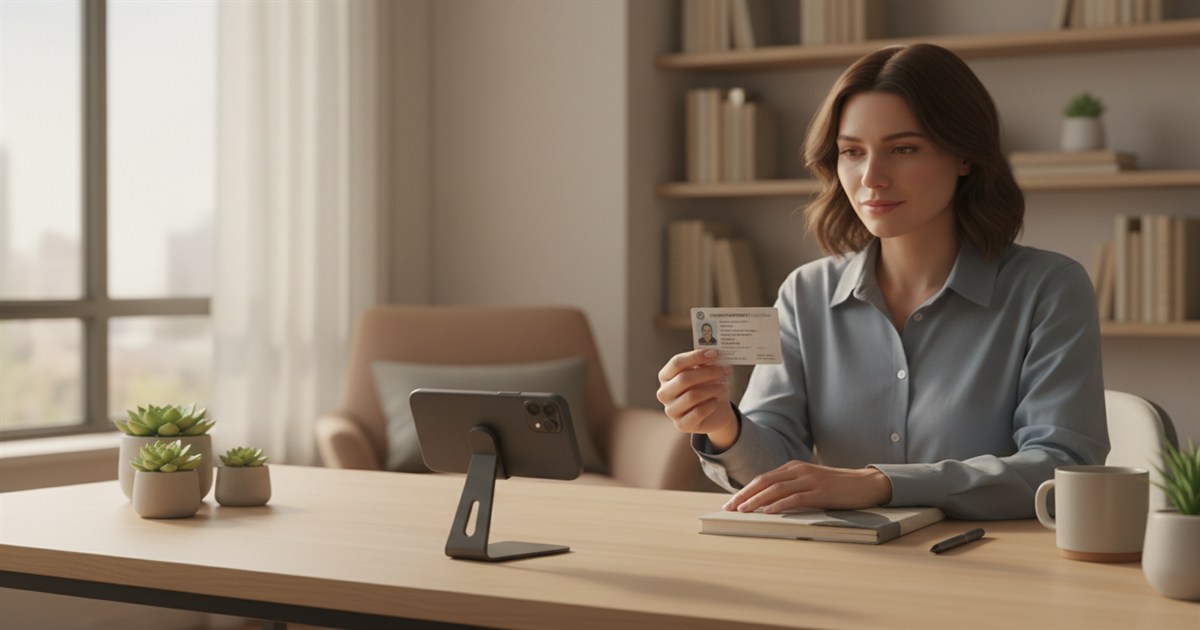
The session opens with the notary on screen and the recording starting. You will be asked to state your name and confirm you are present voluntarily. You will then hold your photo ID up to the camera so the notary can read the name, expiration date, and photo, and can match the face to the person on the call.
This can feel redundant if the platform already verified you. It is not. The database check proves that a person matching your records exists; the live video check proves that the person on the call is that person, right now. Those are separate facts, and a Nevada notarial certificate depends on the second one.
A few practical notes: hold the ID steady and close enough to fill part of the frame, avoid backlight from a window behind you, and have a second form of identification nearby in case the first is expired, damaged, or the name does not match the document.
Minutes three to eight: the signing
Once identity is confirmed, the notary brings the document on screen. Read what you are signing before you sign it — the notary cannot explain what the document means, and should not be asked to. What the notary can do is make sure the notarial block is right, that the correct certificate type is attached, and that you are signing in the right place.
You will sign with a mouse, a finger on a touchscreen, or a stylus. For a jurat, you sign in front of the notary and then swear or affirm to the truth of the document, typically with a spoken "I do." For an acknowledgment, you sign and then acknowledge that the signature is yours. Those two are not interchangeable, which is why the notary will ask which one you want rather than assume.
Anything that requires a witness can generally be handled in the same session, but tell the notary when you book so the witness can be verified too. Turning up to a session expecting the notary to also serve as your witness is the kind of thing that ends in a second appointment.
Minutes eight to ten: the seal, the journal, and the file
The notary applies an electronic seal and signature, which the platform binds to the document so any later edit is detectable. A journal entry is created recording the date, the parties, the document type, and the identification used. The recording of the session is retained by the notary as required.
You leave with a copy of the notarized file. If the recipient needs an original-looking paper copy, print the completed PDF; the electronic version and the printed version carry the same seal information. If the document is headed to another country, notarization is often only the first step and an apostille may be needed as well.
The question everyone asks: do I need to be in Nevada?
No. Remote online notarization is available anywhere in Nevada, and a Nevada notary can also serve signers located outside the state where the platform and the notary's commission allow it. This is the practical difference between the three service types: remote sessions have no geographic limit worth planning around, while mobile and walk-in visits cover the Greater Las Vegas area only, including Henderson and the surrounding suburbs.
That matters if you are in Elko, Reno, or on the road, or if the signer is a relative in another state. It also matters for snowbird households where one spouse is in Nevada and the other is not — both can usually be handled remotely in separate sessions rather than waiting for a trip.
What it costs, and what to have ready
A remote session is priced separately from an in-person visit: $25 for the first signature and $10 for each additional one. A walk-in or mobile visit runs $15 for the first signature and $7.50 for each additional, with a travel fee for mobile work of $30 per hour between 6am and 7pm or $50 per hour after hours, with a two-hour minimum. The pricing page lays out both side by side if you are deciding which fits.
Have ready: photo ID, a quiet private room, a charged device, and the full document. That is genuinely the whole list. If your session needs a witness, add that person and their ID. If you are unsure whether your document can be notarized at all, the FAQ covers the common exclusions, such as certified copies and documents a Nevada notary is not permitted to handle.
If you have never done one of these, the first session feels slower than it is because everything is unfamiliar. The second one takes about eight minutes. Booking a slot on the contact page is the easiest way to confirm timing, ask about witnesses, and get the document checked before the call rather than during it.
More from the blog
- What to Bring to a Notary Appointment in Nevada
- A Notary for Your Small Business, Not Just Your Loan
- Notarizing Documents You Mail Out of State
This article is general information about Nevada notarial practice, not legal advice. I am not an attorney licensed to practice law in Nevada and cannot give legal advice. For guidance about your specific situation, consult a licensed Nevada attorney.